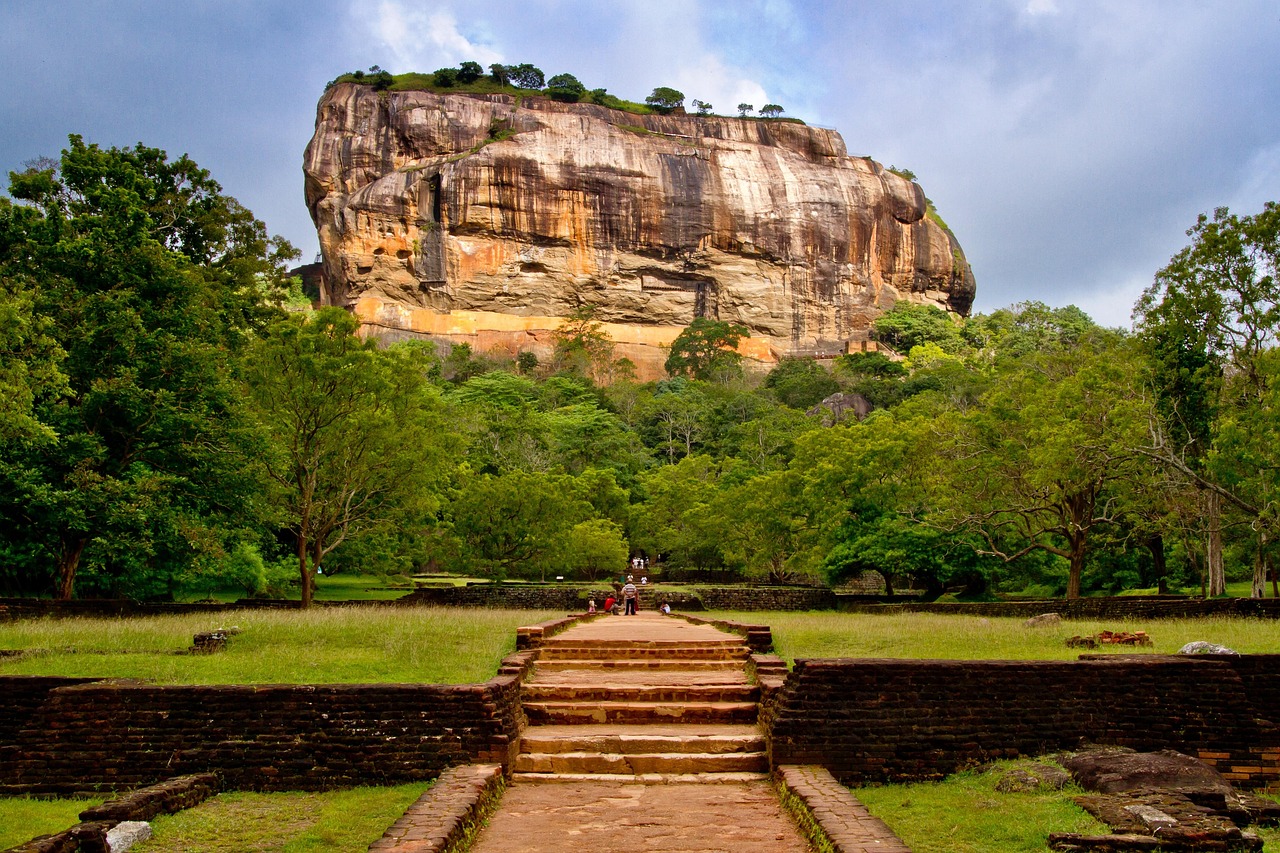
Rising dramatically from the flat plains of Sri Lanka’s Central Province, Sigiriya — also known as the Lion Rock — stands as one of the island’s most captivating and iconic landmarks. This ancient fortress and palace complex, recognized as a UNESCO World Heritage Site, is not just a testament to Sri Lanka’s rich history but also a marvel of engineering and artistry that continues to captivate visitors from around the world.
Sigiriya’s story begins in the 5th century AD when it was transformed into a royal citadel by King Kashyapa (477–495 AD). After overthrowing his father, Kashyapa sought to build an impregnable fortress atop this 200-meter-high granite monolith to protect himself from rival factions and potential invasions. The result was a unique combination of natural defenses and sophisticated urban planning that made Sigiriya one of the most remarkable fortresses of its time.
The approach to Sigiriya starts at its magnificent water gardens, which greet visitors with symmetrical pools, fountains, and island pavilions — a testament to the ingenuity of ancient Sri Lankan landscape architects. As you ascend, you’ll encounter the Boulder Gardens, a series of pathways winding through massive rocks and caves that were once used by Buddhist monks before Kashyapa’s time.
About halfway up the rock face, a spiral staircase leads to the famous Sigiriya Frescoes, a series of exquisite murals depicting celestial maidens known as “Apsaras.” These vivid paintings, believed to date back to the 5th century, remain remarkably well-preserved, offering a glimpse into the artistic brilliance of ancient Sri Lanka.
Nearby, the Mirror Wall — once polished so perfectly that the king could see his reflection — bears ancient graffiti left by visitors from as far back as the 8th century, providing a fascinating insight into the lives and thoughts of those who once admired the site.
The final ascent takes visitors through the Lion’s Paw Terrace, where massive stone paws guard the entrance to the summit. Originally, a colossal lion statue — now mostly lost to time — would have formed the gateway, giving Sigiriya its name (Sinhagiri, meaning Lion Rock).
At the summit, the ruins of King Kashyapa’s royal palace await. Foundations of walls, cisterns, and terraces reveal the grandeur that once crowned the rock. From here, the views stretch endlessly across the surrounding forests, villages, and distant mountains — a breathtaking panorama that rewards every traveler who makes the climb.
Beyond its archaeological wonders, Sigiriya is steeped in legend and mystery. Some believe it was inspired by the mythological Alakamanda, the palace of Kuvera, the god of wealth, while others see it as an elaborate pleasure garden built by a king who dared to dream big.
Today, Sigiriya stands not only as a symbol of Sri Lanka’s rich heritage but also as a place where history, legend, and natural beauty intertwine seamlessly. It is an essential stop for anyone seeking to connect with the soul of this enchanting island.